
New TDS Forms Are Mandatory from This Quarter — Is Your Business Ready?
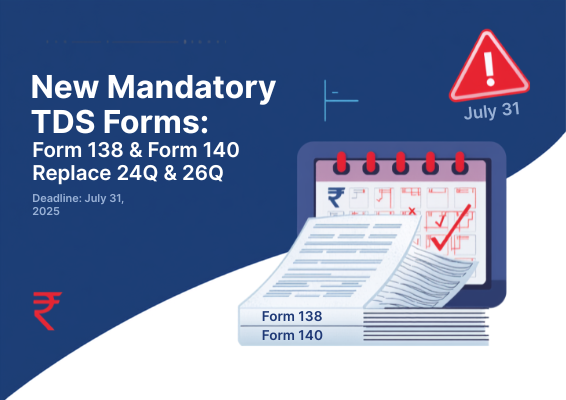
If you run a business that deducts TDS — whether on employee salaries, contractor payments, rent, professional fees, or any other payment — this quarter brought a change you may have completely missed.
The new Income Tax Act, 2025 came into force from April 1, 2026. And with it came new TDS forms that are now mandatory for the very first time this quarter — the April to June 2026 period, with the filing deadline on July 31, 2026.
What Exactly Changed?
Under the old Income Tax Act, 1961, businesses were filing:
- Form 24Q — for TDS deducted on salary payments
- Form 26Q — for TDS deducted on non-salary domestic payments
These forms have now been replaced under the Income Tax Act, 2025 with:
- Form 138 — the new mandatory form for salary TDS (replacing Form 24Q)
- Form 140 — the new mandatory form for non-salary domestic TDS (replacing Form 26Q)
This isn't a minor update or a name change. These are new prescribed forms under the new Act, and Q1 FY 2026-27 (April to June 2026) is the first quarter where they are compulsory.
Why This Matters More Than You Think
Most businesses rely on TDS filing software — either in-house tools, accounting platforms, or their CA's filing system. The critical question is: has that software been updated to generate Form 138 and Form 140 in the correct new format?
If your software is still generating output in the old Form 24Q or Form 26Q structure, your TDS return filed on July 31 may be treated as defective or incorrectly filed — even if all the numbers are right. The format itself matters under the new Act.
Who Does This Affect?
If your business does any of the following, this change applies to you:
- Pays salaries and deducts TDS from employees
- Makes payments to contractors, consultants, or freelancers above threshold limits
- Pays rent, professional fees, commission, or brokerage subject to TDS
- Files quarterly TDS returns — which is a legal requirement if you're a deductor
In short, if you have even one employee or make any TDS-applicable payment, this is your compliance obligation for July 31.
What About the New TDS Certificate Forms?
Along with the new return forms, the certificates issued to deductees have also changed. The new Form 132 is now the TDS certificate for specific transactions including payment of rent, transfer of immovable property, technical services, or transfer of Virtual Digital Assets. If your business issues TDS certificates to vendors or employees, those formats have changed too.
The Risk of Getting This Wrong
Filing the wrong form, or filing in an outdated format, can trigger a defective return notice. Beyond the administrative hassle of rectification, there are downstream consequences — your employees and vendors won't be able to correctly claim TDS credit in their own ITR filings if the form data doesn't match the new system's expectations. That creates friction, complaints, and potential liability for your business.
What You Should Do Before July 31
There are three things worth checking before you file:
First, confirm with whoever handles your TDS filing — internal team or CA — that they are aware of the Form 138 and Form 140 requirement and are not using old form formats.
Second, verify that your payroll or accounting software has been updated. Many popular platforms push these updates quietly — don't assume it has happened without checking.
Third, if you are filing TDS returns yourself without a CA, this is the quarter to pause and get a professional review. A wrong format filing is harder to fix after the deadline than before it.
The Bigger Picture
July 2026 is the first major quarterly compliance milestone under the Income Tax Act, 2025. The new Act runs parallel to the old one for now — FY 2025-26 income is still assessed under the old Act, but TDS obligations from April 2026 onwards are governed by the new Act. This dual-track system is genuinely confusing, and the TDS form change is just one of several areas where businesses can trip up without realising it.
If you're not sure whether your TDS compliance is aligned with the new requirements, it's worth a quick check — 27 days before the deadline is the right time, not 2 days before.
[Contact us today for a TDS compliance review before July 31 →]
Have Questions? We're Here to Help
Get expert advice from SABBANA AND ASSOCIATES. Reach out to discuss your requirements.