
July 31 Is 29 Days Away — A Quick Checklist Before You File Your ITR for FY 2025-26
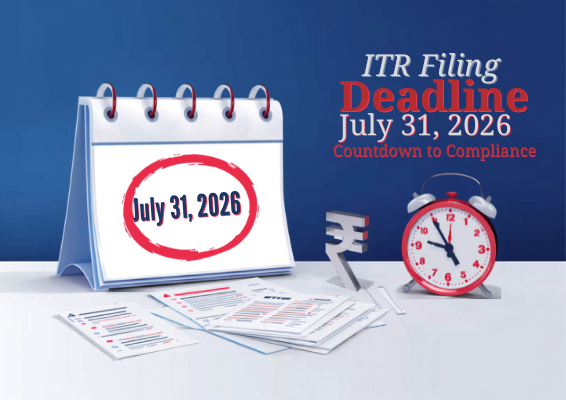
It's July 2 . That means you have 29 days to file your Income Tax Return for FY 2025-26 (AY 2026-27). The good news is that all ITR forms — ITR-1 through ITR-4 — are already live on the e-filing portal. The not-so-good news? A lot of people will wait until the last week, rush through it, and either miss something important or pick the wrong form entirely.
Here's a practical checklist to get ahead of that.
✅ Know Your Deadline First
Not everyone has the same deadline this year:
- July 31, 2026 — Salaried individuals, pensioners, and those filing ITR-1 or ITR-2
- August 31, 2026 — Business income filers using ITR-3 or ITR-4 (non-audit cases)
- October 31, 2026 — Cases requiring a tax audit
If you miss your deadline, a belated return can still be filed up to December 31, 2026 — but it comes with a late fee of up to ₹5,000 (₹1,000 if your total income is below ₹5 lakh), plus interest at 1% per month on any outstanding tax. Certain losses also cannot be carried forward if you file late.
✅ Gather These Documents Before You Start
- Form 16 from your employer (or all employers if you switched jobs)
- Form 26AS and Annual Information Statement (AIS) from the e-filing portal
- Bank statements for interest income
- Capital gains statements from your broker or mutual fund platform
- Rental income records if applicable
- Proof of investments made for deductions (80C, 80D, NPS, HRA, etc.)
✅ Check Your Form 26AS and AIS — Before Anyone Else Does
This is the step most people skip. Your Form 26AS shows TDS deducted and taxes already paid. Your AIS shows what the Income Tax Department already knows about your income — interest, dividends, capital gains, property transactions, and more.
If what you're planning to report doesn't match what's in your AIS, that mismatch doesn't disappear after you file — it often resurfaces as a notice. Check for discrepancies now, not after submission.
✅ Pick the Right ITR Form
This is where a lot of filers go wrong:
- ITR-1 (Sahaj) — Salaried/pensioners with income up to ₹50 lakh, one house property, no capital gains
- ITR-2 — If you have capital gains (stocks, mutual funds, property), income above ₹50 lakh, or more than one house
- ITR-3 — Business or professional income along with salary/capital gains
- ITR-4 (Sugam) — Presumptive income under 44AD/44ADA/44AE
Filing the wrong form makes your return defective — and fixing it after the deadline is a hassle you don't want.
✅ Make the Old vs New Regime Decision Deliberately
If you're filing ITR-1 or ITR-2, you can switch between the old and new tax regime each year. Under the new regime, income up to ₹12 lakh attracts zero tax after rebate — but if you have significant deductions (HRA, 80C, home loan interest), the old regime may still save you more.
This decision is reversible for salaried individuals — but it needs to be made before you file, not after.
✅ Verify Your Bank Account for Refund
If a refund is due, your pre-validated bank account must be correct and active on the portal. A wrong IFSC or a dormant account can delay your refund by months.
✅ Don't Forget to e-Verify
Filing is not complete until you e-verify your return. You can do this via Aadhaar OTP, net banking, or by sending a signed ITR-V to CPC Bengaluru within 30 days of filing. An unverified return is treated as not filed at all.
Sounds like a lot? That's because it is.
Each of these steps has details that matter — wrong form, missed AIS mismatch, incorrect regime choice, or an unverified return can all create problems that are harder to fix after July 31 than before it.
If your income situation is anything beyond basic salary and savings interest — a job change, capital gains, rental income, foreign income, stock options, or freelance work — it's worth getting your return reviewed before you hit submit.
[Get in touch with us today — 29 days is enough time to file it right →]
Have Questions? We're Here to Help
Get expert advice from SABBANA AND ASSOCIATES. Reach out to discuss your requirements.